%20(1).jpg)




Here’s the tough thing for me about conferences: massive, crushing FOMO.
Did I pick the right sessions? Attend the right events? Miss the one panel everyone will casually reference for the next six months? It haunts me as I plan my schedule, attend networking receptions, and stand frozen with indecision in front of the dessert table.
So while I more than appreciated the depth, breadth, and speaker excellence at this year’s Financial Brand Forum, I suspect I’m not alone at wondering what I missed.
I can’t tell you about what I didn’t see, but I can fulfill some semblance of civic/fellow marketer duty and tell you what I did see.
Without further ado, here are my favorite quotes and takeaways from the Financial Brand Forum 2026 conference.
Perhaps my favorite session of the conference was Will Guidara’s “Unreasonable Hospitality.” I worked in the hospitality industry for a number of years, and my wife has spent her entire career in restaurant management, so I really didn’t expect to learn (read: cry) as much as I did.
“Do unscalable things for people all the time” came after Will described how his restaurant knew that a couple had just gotten married at the courthouse. So, the restaurant team paced all the other dinner seatings out so that these two were the last in the restaurant. Then, they invited them upstairs to the event space, which they had set up with music playing through the speakers—so the couple could have a first dance, there, together.
Will spoke about how he enables his teams to perform these one-hit wonders for their customers all the time, but also how he builds in scalable moments, too. Not everyone can have their own first dance, but for anyone who proposes in his restaurant, they first send out free champagne toasts in Tiffany champagne glasses, and then box the Tiffany champagne glasses to gift the couple at the conclusion of their meal.
I loved the pairing of these two tactics: enabling big, one-off gestures when you can, but also finding the moments that matter and making them special at scale.
Mike Cessario is the founder and CEO of Liquid Death, known for its iconic and disruptive marketing tactics. He dismantled the idea of risqué marketing being too risky by discussing how he sees his company’s tactics as efficient marketing, not risky marketing.
Mike said one of their strategies is to just put a lot of weird stuff out there. They’re constantly trying things, launching it on social, and seeing what gets traction. If something starts blowing up, that’s when they’ll turn it into a bigger marketing push. It allows them to be really nimble and keep brand consistency as a punk, satirical company across all its channel touchpoints.
I attended two sessions, one from Ted Brown at Digital Onboarding and another from Ben Udell, Former SVP/Digital Innovation and AI at Lake Ridge Bank, about the importance of good onboarding in the financial space. Both of them discussed how the emergence of digital banking has ruined customer loyalty norms, given how easy it is to open new accounts and move money instantly.
So, what’s an FI to do?
ABO. Always Be Onboarding. Speed today is tablestakes, as highlighted above by how quickly people can take their money and leave.
Looking back at my notes, I saw three components to continuous onboarding:
First, don’t be afraid to communicate regularly with customers. It seems the fear of being annoying is widespread across financial institutions. I think the idea of tying communication to real value-adds, or proposing new products when customers are most primed to use them (like pushing a notification about opening a high-yield account when you notice a big deposit in their checking), is a great way to increase frequency without burning people out.
You need allocated onboarding personnel. This includes leadership who are accountable for onboarding efforts and branch staff who actually have time to spend with customers to keep them engaged (which reminds me of another great quote from the Unreasonable Hospitality talk: “Nothing will take root in the absence of resource”).
Finally, it takes focus. You can’t do everything at once. One speaker recommended that deposits and loans should be the sole focus, as that’s what creates profitability and stickiness, not things like online mobile apps, budget tools, or e-statements. And when it comes to your communication tactics, just pick one channel and be really consistent about it. It’s better to start small and narrow than not start at all.
Overall, though, I think organizations just have to care more about onboarding and retaining loyalty—despite its obvious importance, when one of the speakers asked the room to raise their hand if their institution had a dedicated onboarding team, I would say only about 12 people in a room of 300–400 raised their hands.
This one is a little technical, so bear with me, but there was a really excellent talk from Wil Reynolds at Seer Interactive that got into the weeds about AI search.
His argument is twofold: First, one in five financial institutions have the same name as another financial institution. That makes it really hard for AI to tell which financial institution the user means when they type in their query.
Second, if one financial institution with a name similar to another institution doesn’t publish their rates, or has them coded in a way that’s inaccessible to LLMs, the user might be seeing the wrong rates when they search your institution—meaning if the rates the searcher sees are worse than what you actually offer, you lose before you even get started.
Wil’s takeaway was to do the searches yourself and see how AI is pulling things in. If you have access to Microsoft 365 Copilot, you can ask a question that would require a web search, scroll down to “sources” and click it, and then when the righthand panel opens on desktop listing the citations, hover over the “i” next to “Sources” at the very top to see the list of queries run.
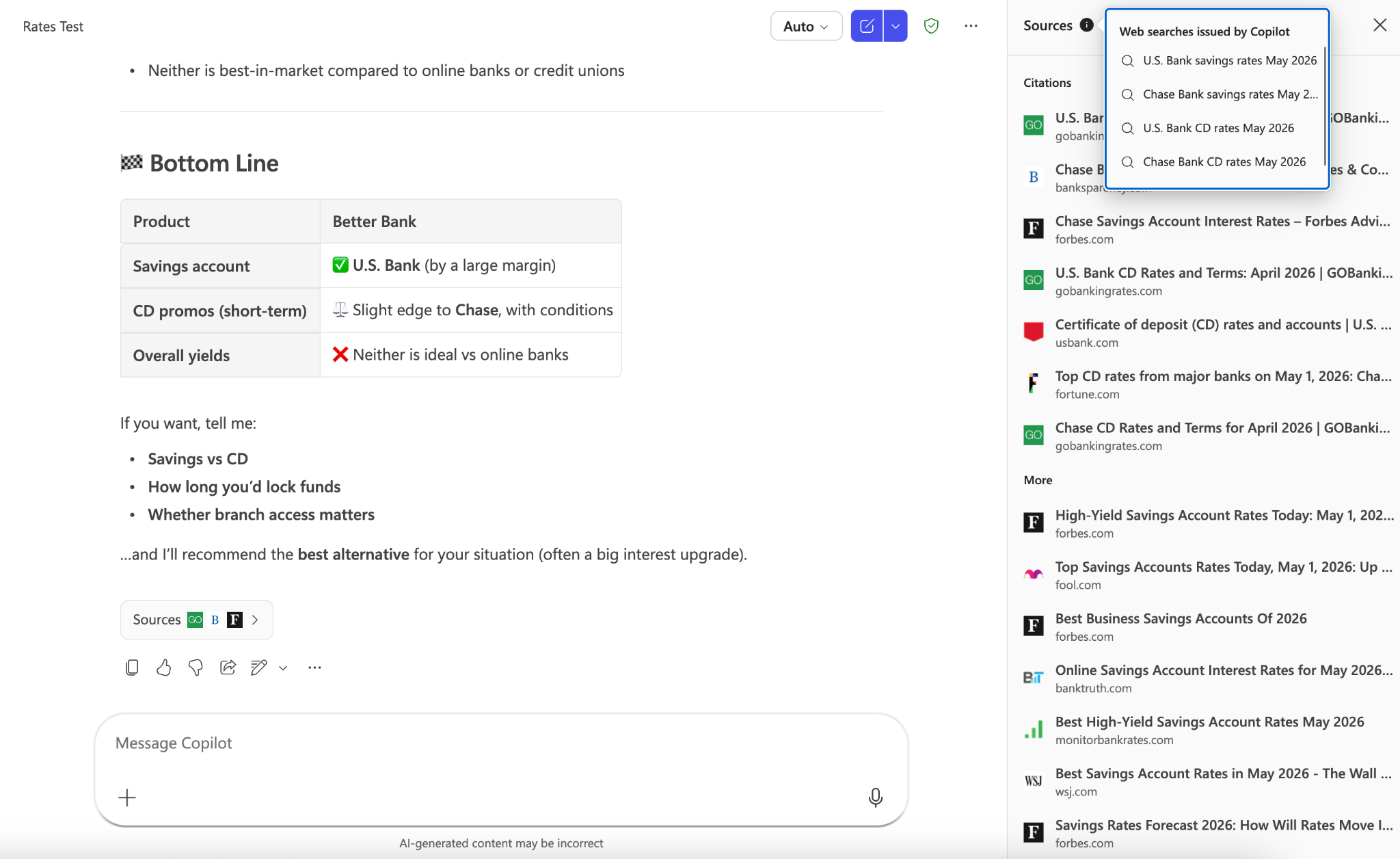
Then, create content that speaks to these queries so that you can own the results AI pulls in—not an affiliate nor a competing institution. And if you have a name that is similar to another financial institution, just know that in the world of AEO, it may be an increasing liability.
Another great talk from Kelly Ball, CEO of Pathfinder, centered around how financial institutions can join FinTok in a meaningful way now that people increasingly turn to financial influencers to get advice and solve problems.
This quote above illustrates the framework he shared for how to create a meaningful content strategy for social media.
Pick your cohort, and make it really specific. Think: college students getting their first job, not someone opening a checking account. Your cohort should have an ongoing tension, not something that will be solved in the short term.
Then, define your role—are you a friend? A teacher?
Finally, what are you helping them navigate? This becomes your content topic list.
I love this formula because it creates something that feels really focused, but it’s also extremely ownable and repeatable—and I think it could help more financial institutions get on TikTok, where expert advice is sorely needed.
-
So, that’s my star list from Financial Brand Forum 2026. What did I miss? If you attended and have a favorite quote or takeaway, send it our way.
Finally, to the staff, speakers, and fellow attendees at FBF—you created a really wonderful event. Thank you from me, and from VSA.